Saturday, 3 October 2015

Luisa Divine Will Prayer Part 1


Billy at Dalmally Retreat.
   www.divinewill.cc/divine_will_prayers.htm

Divine Will Prayers Part 1

·        Home

Prevenient Act
“Most Holy Trinity, I thank and praise You for this new day. Setting my will in Yours, I affirm I want only to live and act in Your Will. Thus, making my “Prevenient Act,” I set all my acts of the day in order in You. (Vol. 14: May 27, 1922)
Good morning, Blessed Mother. I love You. Come, help me offer my first act of the day as an act of love in the Divine Will of God.
Dear Jesus, I desire to fuse myself to Your holy, adorable and Divine Will. I tie these and all my acts to each and every act that the creatures who live in the Divine Will of God have, will, and are doing, unto the last one that will be completed upon the earth. I love You, I adore You, I bless You, I praise You, and I thank You with Your Will. Amen!
Morning Prayer in the Divine Will
As our eyes open to the light of day, let us make our whole being rise in the Light of the Will of God, and let us begin our Rounds.
The first act must be an act of love in the Divine Will. Let us make this act diffuse in all intelligences of the creatures, in all gazes, in the words, in the motion, in the steps, in the heartbeats, in each breath.
Then let us bind all of these acts of ours with those done by Adam in the Holy Will of God, with those that the creatures who will live in the Divine Will will do, up to the last one that will be done on Earth.

Let us take all this love spread throughout Creation and make it our own, and then let us offer it to our Creator.” 
Let us rise a little higher, then, into Creation. For love of the creature God created the sun, the stars, the sea, the earth, the birds, the flowers; and we, let us take all this love spread throughout Creation and make it our own, and let us offer it to our Creator as so many acts of homage, of love, of blessings and of praises.
And now, let us go higher up there in Paradise. Let us go through all the Angels and through all the Saints; let us unite ourselves with the whole celestial Court, and let us give an act of love to Jesus for all and for each one.
Then, let us draw near the Virgin, our dear Mother. She is ready to give us all of Her merits as gift, and we with the confidence of children, let us take all that She has done, from the very first moment of Her Conception up to Her last breath, and let us offer it to our God as if everything were our own.
And then let us go to the Word, and ask Him to let us take part in all of His acts: His Conception, His birth, the flight to Egypt, the thirty years of his hidden life, the three years of His public life, His Passion, His death, His Ascension into Heaven. He has done all this for us; let us make it our own, and let us offer it to the Sacrosanct Trinity. Only in this way, miserable creatures as we are, can we offer the most complete and holy act, because in this way the creature gives nothing of her own, but gives back to God all the glory that comes to her from what He Himself 
has done.
Luisa's prayer to bring Jesus to her
O Jesus, come, give me your hand; let me enter into your Holy Will, that I may fill the whole atmosphere, the blue Heaven, the Light of the Sun, the air, the sea, everything — everything, with my “I Love You”, with my kisses; so that, everywhere You may be, if You look, You may look at my “I Love You” and at my kisses; if you hear, You may hear my “I Love You” and the smacking of my kisses; if You speak and breathe, You may breathe my "I love You" and my anguishing kisses. If You work, may my “I Love You's” flow in your hands; if you walk and tread the ground may my “I Love You”and the roaring of my kisses be under your steps... May my “I Love You” be the chain that draws You to me, and may my kisses be the powerful magnet that, whether You want it or not, force You to visit the one who cannot live without You.” (Volume 16, August 1, 1923)

Luisa's goodnight to Jesus in
the Blessed Sacrament
O my Jesus, celestial Prisoner, the sun is now setting, the darkness invades the earth, and you remain alone in the Tabernacle of love. I seem to see You there in an air of sadness for the loneliness of the night, because You don't have around You the crown of your sons and of your tender spouses, who may at least keep You company in this voluntary imprisonment.

Friday, 2 October 2015

Guardian Angels, St. Bernard 'That they might guard you in all your ways'

Community Liturgy Office - drawings

We thank iBreviary for the St. Bernard illuminations on our Guardian Angels.

      
iBreviary
Friday, 2 October 2015
Friday of the Twenty-Sixth Week in Ordinary Time
Type: Weekday - Time: Ordinary


SECOND READING

From a sermon by Saint Bernard, abbot
(Sermo 12 in psalmum Qui habitat, 3. 6-8: Opera omnia, Edit. Cisterc. 4 [1966], 458-462)

That they might guard you in all your ways


He has given his angels charge over you to guard you in all your ways. Let them thank the Lord for his mercy; his wonderful works are for the children of men. Let them give thanks and say among the nations, the Lord has done great things for them. O Lord, what is man that you have made yourself known to him, or why do you incline your heart to him? And you do incline your heart to him; you show him your care and your concern. Finally, you send your only Son and the grace of your Spirit, and promise him a vision of your countenance. And so, that nothing in heaven should be wanting in your concern for us, you send those blessed spirits to serve us, assigning them as our guardians and our teachers.

He has given his angels charge over you to guard you in all your ways. These words should fill you with respect, inspire devotion and instill confidence; respect for the presence of angels, devotion because of their loving service, and confidence because of their protection. And so the angels are here; they are at your side, they are with you, present on your behalf. They are here to protect you and to serve you. But even if it is God who has given them this charge, we must nonetheless be grateful to them for the great love with which they obey and come to help us in our great need.

So let us be devoted and grateful to such great protectors; let us return their love and honor them as much as we can and should. Yet all our love and honor must go to him, for it is from him that they receive all that makes them worthy of our love and respect.

We should then, my brothers, show our affection for the angels, for one day they will be our co-heirs just as here below they are our guardians and trustees appointed and set over us by the Father. We are God’s children although it does not seem so, because we are still but small children under guardians and trustees, and for the present little better than slaves.

Even though we are children and have a long, a very long and dangerous way to go, with such protectors what have we to fear? They who keep us in all our ways cannot be overpowered or led astray, much less lead us astray. They are loyal, prudent, powerful. Why then are we afraid? We have only to follow them, stay close to them, and we shall dwell under the protection of God’s heaven.
RESPONSORY
Psalm 91:11-12, 10


God gave his angels charge over you
to protect you in all your ways.
 They shall lift you up with their hands,
lest you strike your foot against a stone.

No evil shall harm you,
no plague shall come near your tent.
 They shall lift you up with their hands,
lest you strike your foot against a stone.

CONCLUDING PRAYER

Let us pray.

God, our Father,
in your loving providence
you send your holy angels to watch over us.
Hear our prayers, defend us always by their protection
and let us share your life with them for ever.
We ask this through our Lord Jesus Christ, your Son,
who lives and reigns with you and the Holy Spirit,
one God, for ever and ever.
 Amen.

Thursday, 1 October 2015

Saint Therese of the Child of Jesus 'Sent like Lambs'


Thursday 0f the Twenty Sixth Week in Ordinary Time
Night Office: from Ida Gorres.


Introduction to Mass
St Therese of the Child Jesus (1 October 2015) – Fr Hugh

Our Lord has told us that unless we become like little children we will not enter the Kingdom of Heaven.  Childlike not childish.  St Therese exemplified this.

One of the characteristics of a child is a sense of wonder.

At Confirmation the prayer over the candidates asks that they may receive the Spirit of Wonder and Awe at God’s presence.  This is one of the Seven Gifts of the Holy Spirit – Wisdom, Understanding, Counsel, Fortitude, Knowledge, Piety and Wonder and Awe at God’s Presence (also called Fear of the Lord.).

________________________________________________________________________________


Poem from St. Therese
. A LAMB.
Would you charm the Lamb of God?
In the path that He hath trod
Tread to-day with willing feet!
Leaving all things here below,
Seek alone His will to know;
Do His will surpassing sweet!

 cf. Lk. 10:3 'out like lambs'

A Reading about St. Teresa of Lisieux, from a Book by Ida Gorres*

IN Teresa herself, during every hour of her life, the sustaining foundation of the Church was made manifest. The details of this fabric were too small individually to be singled out by the eye; but together they formed the ground out of which everything else grew.

Teresa thought and talked like a nun of her period. She had amazingly little understanding of "the world", of the natural, ordinary life outside the convent walls. But she lived the sanctity and transparency of ordinary human life. Her essential experiences of God, her conclusions from them, were not founded upon or inspired by the special insights of the mystics, nor upon the tradition of the Carmelite Order. They derived from the homely traditions of a good family, from the simple everyday, catechism-nourished devotion of father and mother. Thus she became–like Francis de Sales, her great spiritual ancestor–a teacher of that lay spirituality which is so much discussed nowadays; just as, conversely, all monastic piety has always been nourished by the primordial example of marital and parental love. Only God knows the number of souls who share in the honour and the reward of this one saint. In her glorification there is revealed, as through a rent in the curtain, both as consolation and promise, and comprehensible to the earthly heart, a gleam of that which awaits the lowliest in our Father's House.

St. Pius X is said to have prophetically called Teresa, whose full rise to fame he did not live to witness, the greatest saint of the century. May we be permitted to understand him in that way. He, the saintly Pope who restored to the ordinary Christian the forgotten heritage which for centuries had been the privilege only of the clergy or of the most devout–free access to the Eucharist; he who again recognized that the participation of the laity was the lifeblood of the liturgy and thus broke down the artificial dividing wall between clergy and people~ act of enormous significance may well have understood that this little Carmelite stands for innumerable souls, for the legions of those to whom she revealed it for the first time. Therefore she stands precisely on the crossroads between the "old" and the "new" piety. She is a remarkable example of the invincible powers of renewal in the Mystical Body of Christ, of the activity of the Holy Spirit, whose creative power is ever at work. And she is all that precisely because she lived so apart from and so innocent of all the discussions and disputes over reform and rebirth.

It is a, source of deepest...happiness to see in the Church this process of self-purification for once not manifesting itself in the form of protest against abuses, or conflict and strife with the world, but welling up from the clear spring of a child's soul.

In Teresa there gathered and became purified the deep, intimate essential unchanging elements of the Faith and of Love. As the perfected butterfly, breaks out of the chrysalis, so she emerges transformed from the shrivelling shell of her period and appears before us as the pure embodiment of Christian reality.
To be sure, she represents also a perfection of the period's religious ideal; but in fulfilling the law of her own being, she overcomes it. She who knew only obedience, only listening, unquestionably accepted the highly questionable elements in her contemporaries' piety. But the pruning purity of her touch melted away all the old slag. What she grasped and what she embodied is one again the beginning, the core, the original meaning. We see in her girlish face the hidden face of the Church, the Face of the Hidden Church, which in the chaos of time flowers, eternally young and beautiful, to greet the re­turning Lord.

* The Hidden Face, New York 1969, 412-414.
   
SAINT THERESE OF LISIEUX
MEDITATION      OF THE       DAY
From Magnificat com
Sent Like Lambs
O my Jesus! I love you! I love the Church, my Mother!
I recall that "the smallest act of PURE LOVE is of more value to her than all other works together" (Saint John of the Cross). But is PURE LOVE in my heart? Are my measure­less desires only but a dream, a folly? Ah if this be so, Jesus, then enlighten me, for you know I am seeking only the truth. If my desires are rash, then make them disappear, for these desires are the greatest martyrdom to me. However, I feel, 0 Jesus, that after having aspired to the most lofty heights of Love, if one day I am not to attain them, I feel that I shall have tasted more sweetness in my martyrdom and my folly than I shall taste in the bosom of the joy of the Fatherland, unless you take away the memory of these earthly hopes through a miracle. Allow me, then, during my exile, the delights of love. Allow me to taste the sweet bitterness of my martyrdom.

Jesus, 0 Jesus, if the desire of loving you is so delightful, what will it be to possess and enjoy this Love?

How can a soul as imperfect as mine aspire to the possession of the plenitude of Love? 0 Jesus, my first and only Friend, you whom I love UNIQUELY, explain this mystery to me! Why do you not reserve these great aspirations for great souls, for the eagles that soar in the heights?

I look upon myself as a weak little bird, with only a light down as covering. I am not an eagle, but I have only an eagle's EYES AND HEART. In spite of my extreme littleness I still dare to gaze upon the divine Sun, the Sun of Love, and my heart feels within it all the aspi­rations of an eagle.

SAINT THERESE OF LISIEUX Saint Therese of Lisieux (+ 1897) was declared a Doctor of the Church in 1997.
Prayer for the Evening

Wednesday, 30 September 2015

Dom Donald's Blog: Saint Thérèse of the Child Jesus (1873-1897), Carm...

 Wednesday of the Twenty-sixth week in Ordinary Time

Wednesday, 1 October 2014

Saint Thérèse of the Child Jesus (1873-1897), Carmelite, Doctor of the Church


Santa_Teresa_di_Gesu_Bambino-di_Lisieux-BA

Wednesday, 01 October 2014


Saint Thérèse of the Child Jesus (1873-1897), Carmelite, Doctor of the Church     
 
Poem « Jesus, my beloved, remember ! » ; v. 1, 6-8 
"The Son of Man has nowhere to rest his head"

Remember the Father's glory, 
Remember the divine splendor 
You left in exiling yourself on earth 
To redeem all the poor sinners. 
O Jesus! Humbling yourself to the Virgin Mary, 
You veiled your infinite greatness and glory. 
Ah! Your mother's breast 
Was your second heaven, 
Remember… 

Remember that on other shores 
The golden stars and silver moon 
On which I gaze in the cloudless sky 
Delighted and charmed your Infant eyes. 
With your little hand that caressed Mary 
You upheld the world and gave it life, 
And you thought of me, 
Jesus, my little King, 
Remember. 

Remember that you worked in solitude 
With your divine hands. 
To live forgotten was your sweetest task. 
You rejected human learning. 
O You who with just one word could charm the world, 
You took delight in hiding your profound wisdom. 
You seemed unlearned, 
O All-powerful Lord! 
Remember. 

Remember that you wandered as a Stranger on earth. 
You, the Eternal Word, 
You had nothing, no, not even a stone, 
Not a shelter, like the birds of heaven. 
O Jesus! come within me, come rest your Head, 
Come, my soul is truly ready to receive you. 
My Beloved Savior, 
Rest in my heart. 
It is Yours. 
Saint Therese of Lisieux
Virgin and Doctor of the Church
(1873-1897)
        Thérèse Martin was born at Alençon, France on 2 January 1873. Two days later, she was baptized Marie Frances Thérèse at Notre Dame Church. Her parents were Louis Martin and Zélie Guérin. After the death of her mother on 28 August 1877, Thérèse and her family moved to Lisieux.


        Towards the end of 1879, she went to confession for the first time. On the Feast of Pentecost 1883, she received the singular grace of being healed from a serious illness through the intercession of Our Lady of Victories. Taught by the Benedictine Nuns of Lisieux and after an intense immediate preparation culminating in a vivid experience of intimate union with Christ, she received First Holy Communion on 8 May 1884. Some weeks later, on 14 June of the same year, she received the Sacrament of Confirmation, fully aware of accepting the gift of the Holy Spirit as a personal participation in the grace of Pentecost.
        She wished to embrace the contemplative life, as her sisters Pauline and Marie had done in the Carmel of Lisieux, but was prevented from doing so by her young age. On a visit to Italy, after having visited the House of Loreto and the holy places of the Eternal City, during an audience granted by Pope Leo XIII to the pilgrims from Lisieux on 20 November 1887, she asked the Holy Father with childlike audacity to be able to enter the Carmel at the age of fifteen.
        On 9 April 1888 she entered the Carmel of Lisieux. She received the habit on 10 January of the following year, and made her religious profession on 8 September 1890 on the Feast of the Birth of the Blessed Virgin Mary.
        In Carmel she embraced the way of perfection outlined by the Foundress, Saint Teresa of Jesus, fulfilling with genuine fervour and fidelity the various community responsibilities entrusted to her. Her faith was tested by the sickness of her beloved father, Louis Martin, who died on 29 July 1894. Thérèse nevertheless grew in sanctity, enlightened by the Word of God and inspired by the Gospel to place love at the centre of everything. In her autobiographical manuscripts she left us not only her recollections of childhood and adolescence but also a portrait of her soul, the description of her most intimate experiences. She discovered the little way of spiritual childhood and taught it to the novices entrusted to her care. She considered it a special gift to receive the charge of accompanying two "missionary brothers" with prayer and sacrifice. Seized by the love of Christ, her only Spouse, she penetrated ever more deeply into the mystery of the Church and became increasingly aware of her apostolic and missionary vocation to draw everyone in her path.
        On 9 June 1895, on the Solemnity of the Most Holy Trinity, she offered herself as a sacrificial victim to the merciful Love of God. At this time, she wrote her first autobiographical manuscript, which she presented to Mother Agnes for her birthday on 21 January 1896.
        Several months later, on 3 April, in the night between Holy Thursday and Good Friday, she suffered a haemoptysis, the first sign of the illness which would lead to her death; she welcomed this event as a mysterious visitation of the Divine Spouse. From this point forward, she entered a trial of faith which would last until her death; she gives overwhelming testimony to this in her writings. In September, she completed Manuscript B; this text gives striking evidence of the spiritual maturity which she had attained, particularly the discovery of her vocation in the heart of the Church.
        While her health declined and the time of trial continued, she began work in the month of June on Manuscript C, dedicated to Mother Marie de Gonzague. New graces led her to higher perfection and she discovered fresh insights for the diffusion of her message in the Church, for the benefit of souls who would follow her way. She was transferred to the infirmary on 8 July. Her sisters and other religious women collected her sayings. Meanwhile her sufferings and trials intensified. She accepted them with patience up to the moment of her death in the afternoon of 30 September 1897. "I am not dying, I am entering life", she wrote to her missionary spiritual brother, Father M. Bellier. Her final words, "My God..., I love you!", seal a life which was extinguished on earth at the age of twenty-four; thus began, as was her desire, a new phase of apostolic presence on behalf of souls in the Communion of Saints, in order to shower a rain of roses upon the world.
        She was canonized by Pope Pius XI on 17 May 1925. The same Pope proclaimed her Universal Patron of the Missions, alongside Saint Francis Xavier, on 14 December 1927.
        Her teaching and example of holiness has been received with great enthusiasm by all sectors of the faithful during this century, as well as by people outside the Catholic Church and outside Christianity.
        On the occasion of the centenary of her death, many Episcopal Conferences have asked the Pope to declare her a Doctor of the Church, in view of the soundness of her spiritual wisdom inspired by the Gospel, the originality of her theological intuitions filled with sublime teaching, and the universal acceptance of her spiritual message, which has been welcomed throughout the world and spread by the translation of her works into over fifty languages.
        Mindful of these requests, His Holiness Pope John Paul II asked the Congregation for the Causes of Saints, which has competence in this area, in consultation with the Congregation for the Doctrine of the Faith with regard to her exalted teaching, to study the suitability of proclaiming her a Doctor of the Church.
        On 24 August, at the close of the Eucharistic Celebration at the Twelfth World Youth Day in Paris, in the presence of hundreds of bishops and before an immense crowd of young people from the whole world, Pope John Paul II announced his intention to proclaim Thérèse of the Child Jesus and of the Holy Face a Doctor of the Universal Church on World Mission Sunday, 19 October 1997.


- Copyright © Libreria Editrice Vaticana
   Dom Donald's Blog: Saint Thérèse of the Child Jesus (1873-1897), Carm...: Santa_Teresa_di_Gesu_Bambino-di_Lisieux-BA Wednesday, 01 October 2014 Wednesday of the Twenty-sixth week in Ordinary Time Saint ...


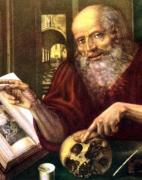
Saint Jerome / September 30 Text prepared by the Benedictines of Stanbrook, 1971

An image of Saint Jerome  http://www.spirituality.org/is/194/saint.asp

     
Saint Jerome / Doctor of the Church.
St Jerome was born in Dalmatia about the year 340. He studied in Rome and was later baptised. He then began to lead a life of asceticism. He went to the East and was there ordained priest. Returning to Rome he became secretary to Pope St Damasus and began the task of translating the Bible into Latin, as well as promoting the monastic life. He settled in Bethlehem where he gave great help in the needs of the Church. He wrote many works especially commentaries on the Scriptures. He died at Bethlehem in the year 420.

A Reading from a Letter of St Jerome to Rusticus.
No one is happier than the Christian, for in him is promised the kingdom of heaven: no-one is more toil-worn, for every day he goes in danger of his life. Nothing isstronger than he is, for he triumphs over the devil: nothing is weaker, for
he is conquered by the flesh.
If you wish to be, and not merely seem, a monk, have regard not for your property - you began your vows by renouncing it - but for your soul. Let a coarse tunic prove that you despise the world. Let your fasts be moderate: a frugal, temperate diet is good for both body and soul. Always have a book in your hand and before your eyes; learn the psalms word by word, pray without ceasing, keep your senses on the alert and closed against vain imaginings. Let your mind and body both strain towards the Lord; overcome wrath by patience; love the knowledge of the Scriptures and you will not love the sins of the flesh. Do not let your mind offer a lodging to disturbing thoughts, for if they once find a home in your breast they will become your masters and lead you on into fatal sin. Engage in some occupation, so that the devil will always find you busy. If the apostles who had the power to make the Gospel their livelihood still worked with their hands that they might not be a burden on any man, why should not you provide for your own future wants?

Make creels of reeds or weave baskets of pliant osiers. Hoe the ground and mark it out into equal plots, and when you have sown cabbage seed or set plants in rows, bring water down in channels. Graft barren trees with buds or slips so
that you may, after a little time, pluck sweet fruit as a reward for your labours.
Make hives for bees, for to them the Proverbs of Solomon send you, and by watching the tiny creatures learn the ordinance of a monastery and the discipline of a kingdom. Twist lines too for catching fish, and copy out manuscripts, so that your own hand may earn your food and your soul be satisfied with reading. 'Everyone that is idle is a prey to vain desires.'
The task is hard, and great and difficult; but great also are the rewards.
Letter CXXV. ET: F.A. Wright.
(Text prepared by the Benedictines of Stanbrook, 1971)


St. Jerome Priest and Doctor of the Church Sept. 30


St. Jerome (or Jerome) Priest and Doctor of the Church
    Sept. 30
Stridone (border between Dalmatia and Pannonia), ca. 347 - Bethlehem, 420
He studied and encyclopedic but led to asceticism, he retired to the desert at Antioch, living in penance.Became a priest on condition of preserving its independence as monaco, began an intense literary activity.In Rome he worked with Pope Damasus, and, at his death, he returned to Jerusalem where he participated in numerous disputes through faith, founding not far from the Church of the Nativity, the monastery where he died. Of fiery character, especially in his writings, he was a mystic and provoked controversy or consensus, castigating vices and hypocrisies. Indefatigable writer, great scholar and excellent translator, he was responsible for the Latin Vulgate Bible, to which he added the comments, still as important as those on the books of the Prophets.
Patronage: archaeologists, librarians, scholars
Etymology: Jerome = name of the sacred, from the greek
Emblem: Hat Cardinal Leone
Martyrology: Memory of St. Jerome, priest and doctor of the Church, was born in Dalmatia, in today's Croatia, a man of great literary culture, he made ​​all his studies in Rome and was baptized here; then abducted by the charm of a life of contemplation, he embraced the ascetic life and, when he went to the East, he was ordained priest. Back in Rome, he became secretary of Pope Damasus, and then settled at Bethlehem in Judah, he retired to monastic life. He was an outstanding doctor in translating and explaining the Scriptures and was a participant in a wonderful way the different needs of the Church. Finally arrived at an advanced age, he rested in peace. 
Then you will generously be granted entrance
into the kingdom of our Lord and Savior Jesus Christ.
SECOND READING

From the prologue of the commentary on Isaiah by Saint Jerome, priest
(Nn. 1. 2: CCL 73, 1-3)

Ignorance of Scripture is ignorance of Christ


I interpret as I should, following the command of Christ: Search the Scriptures, and Seek and you shall find. Christ will not say to me what he said to the Jews: You erred, not knowing the Scriptures and not knowing the power of God. For if, as Paul says, Christ is the power of God and the wisdom of God, and if the man who does not know Scripture does not know the power and wisdom of God, then ignorance of Scripture is ignorance of Christ.

Therefore, I will imitate the head of a household who brings out of his storehouse things both new and old, and says to his spouse in the Song of Songs: I have kept for you things new and old, my beloved. In this way permit me to explain Isaiah, showing that he was not only a prophet, but an evangelist and an apostle as well. For he says about himself and the other evangelists: How beautiful are the feet of those who preach good news, of those who announce peace. And God speaks to him as if he were an apostle: Whom shall I send, who will go to my people? And he answers: Here I am; send me.

No one should think that I mean to explain the entire subject matter of this great book of Scripture in one brief sermon, since it contains all the mysteries of the Lord. It prophesies that Emmanuel is to be born of a virgin and accomplish marvelous works and signs. It predicts his death, burial and resurrection from the dead as the Savior of all men. I need say nothing about the natural sciences, ethics and logic. Whatever is proper to holy Scripture, whatever can be expressed in human language and understood by the human mind, is contained in the book of Isaiah. Of these mysteries the author himself testifies when he writes: You will be given a vision of all things, like words in a sealed scroll. When they give the writings to a wise man, they will say: Read this. And he will reply: I cannot, for it is sealed. And when the scroll is given to an uneducated man and he is told: Read this, he will reply: I do not know how to read.

Should this argument appear weak to anyone, let him listen to the Apostle: Let two or three prophets speak, and let others interpret; if, however, a revelation should come to one of those who are seated there, let the first one be quiet. How can they be silent, since it depends on the Spirit who speaks through his prophets whether they remain silent or speak? If they understood what they were saying, all things would be full of wisdom and knowledge. But it was not the air vibrating with the human voice that reached their ears, but rather it was God speaking within the soul of the prophets, just as another prophet says: It is an angel who spoke in me; and again, Crying out in our hearts, Abba, Father, and I shall listen to what the Lord God says within me.

RESPONSORY
See 2 Timothy 3:16-17; Proverbs 28:7


All Scripture is inspired by God and is valuable
for teaching and for showing the way to holiness,
 so that the man of God might be fully qualified and equipped for every good work.

The wise son is one who keeps God’s law.
 So that the man of God might be fully qualified and equipped for every good work.

CONCLUDING PRAYER

Let us pray.

Father,
you gave Saint Jerome delight
in his study of holy scripture.
May your people find in your word
the food of salvation and the fountain of life.
We ask this through our Lord Jesus Christ, your Son,
who lives and reigns with you and the Holy Spirit,
one God, for ever and ever.
 Amen.

Tuesday, 29 September 2015

The Angels by Anscar Vonier


s

Anscar Vonier 2nd Abbot at Buckfast
     Night Office Readings,

SAINT MICHAEL AND ALL ANGELS
Feast.

29 September 2015
Gospel Mass John 1:47-51

Alternative Reading
From The Angels by Anscar Vonier (pages 84-89)

It is evident by all the laws of spiritual life that angelic beings must be, in one way or another, a great element in the consti­tution of man's eternal happiness. The bliss of the elect will be essentially this - to possess all truth, to be in contact with all reality, to see all beauty. To see the angels, to behold them, must of necessity constitute a source of happiness greater than anything which the visible world could afford; in fact, it is the supreme created source of happiness; God himself, clearly seen in the beatific vision, being the uncreated source of happiness. To be with the angels, to see them in their glory, is a most legitimate desire in the heart of man, and the saints of God have often given utterance to such a longing. We must always keep alive within us that essentially Catholic principle· of life, that the possession of the supreme Goodness, God himself, never destroys the appetite for created goodness, but, on the contrary, enhances it; to see God face to face produces in the minds of the elect a new capacity to see him in his creatures, and where is he seen to greater advantage than in the world of angels, which mirrors back, with an almost infinite power of radiation, the glory of the invisible God? Moreover, through the communion of supernatural grace man is allied to the angels by the bond of charity, he is not a foreigner but he is a fellow-citizen. There will be this truest exchange of love between man and the heavenly spirits: man, besides beholding the angels in their glory, will hold intercourse with them as citizens of the same kingdom, as the children of the same Father. This intercourse with the heavenly spirits will be the last thing in created love; greater love than that there could not be except man's communion with God himself.

There is, however, something deeper than this association with the angels in vision and love. It is Catholic tradition that the elect of the human race are destined to take the place of the fallen spirits, to fill up the gap made by the apostasies of the rebellious angels. This tradition profoundly modifies man's relationship to the angels; it puts him on a footing of equality with those mighty beings which is the most astonishing of all spiritual exaltations.

That there will be more than mere association of men and angels in the glory of eternity is clear from our Lord's words in speaking of the elect at the resurrection: Neither can they die anymore: for they are equal to the angels and are the children of God, being the children of the resurrection. This equality is entirely based on grace. Human nature will always remain what it is, vastly inferior to the angelic nature; but such is the power of grace that the inequality of nature is bridged over, and an elect from the human race may truly become, in all literalness of language, the equal of the highest angel.

Then again there are those human beings who will be absolutely superior by the very laws of their predestination to every angelic order; the blessed Mother of God is certainly one such creature.

The all-pervading principle is this: that grace is greater than nature, greater even than the highest spirit nature, and its scope is vaster than the vastest world.


On September 29th we honor the three archangels mentioned by name in Scripture, Michael, Gabriel, and Raphael. Michael is mentioned in Daniel and Revelation ...


The Angels
.......

The Angels

by Dom Anscar Vonier. OSB

Availability: In stock
....

.......


.....


Details

First published in 1928, this book will satisfy that multitude of questions you have always had about angels and leave you with a happy closeness to those angelic friends of God and man. Subjects covered: Nature, life, sanctity of angels, guardian angels, evil spirits, and ....

Quick Overview

First published in 1928, this book will satisfy that multitude of questions you have always had about angels and leave you with a happy closeness to those angelic friends of God and man. Subjects covered: Nature, life, sanctity of angels, guardian angels, evil spirits, and more..

Luisa Piccarreta. Volume 6. November 23, 1903 There is no beauty that equals suffering for God alone.

29 September 2015
Book of Heaven, Luisa Piccarreta.
Volume 6.
There is no beauty that equals suffering for God alone. 


I felt impressed in my interior by what I had written above, as if it were not according to the truth; so, as soon as I saw blessed Jesus, 

I said: Lord, what I have written is not right; how can there be all this through mere suffering?’  
And He: My daughter, do not be surprised.  Indeed, there is no beauty that equals suffering for the love of God alone.  Two arrows come from Me continuously: one from my Heart, which is of love, and wounds all those who are on my lap, that is, those who are in my grace.  This arrow wounds, mortifies, heals, afflicts, attracts, reveals, consoles and continues my Passion and Redemption in those who are on my lap.  The other comes from my throne, and I entrust it to the Angels who, as my ministers, make this arrow flow over any kind of people, chastising them and exciting all to conversion.”  

Now, while He was saying this, He shared His pains with me, telling me: 
Here in you also, is the continuation of Redemption.”