
 |
| Stained glass window at Lindisfarne 1320 t Cuthbert in pontificals holding head of St Oswald |
SAINT CUTHBERT OF LINDISFARNE
4th September.
Orphaned at an early age. Shepherd. Received a vision of Saint Aidan of Lindesfarne entering heaven; the sight led Cuthbert to become a Benedictine monk at age 17 at the monastery of Melrose, which had been founded by Saint Aidan. Spiritual student of Saint Boswell. Priorof Melrose in 664.
Due to a dispute over liturgical practice, Cuthbert and other monks abandoned Melrose for Lindisfarne. There he worked with Saint Eata. Prior and then abbot ofLindesfarne until 676. Hermit on the Farnes Islands. Bishop of Hexham, England. Bishop ofLindesfarne in 685. Friend of Saint Ebbe the Elder. Worked with plague victims in 685. Noted (miraculous) healer. Had the gift of prophecy.
Evangelist in his diocese, often to the discomfort of local authorities both secular and ecclesiastical. Presided over his abbey and his diocese during the time when Roman rites were supplanting theCeltic, and all the churches in the British Isles were brought under a single authority.
2009
 |
| Hills around Channelkirk ,
Oxton, Nr Lauder The pictures below illustrate the place of Saint Cuthbert watching over his sheep on the Lammermuir Hills. |
 Channelkirk Wall Hanging

CHANNELKIRK WALL HANGING
The Channelkirk Wall Hanging, which depicts the history of the parish over the ages, was embroidered by ladies and gentlemen of the parish and completed as part of the 750th anniversary of the consecration of the church.
The central figure is that of Saint Cuthbert watching over his sheep on the Lammermuir Hills. Behind him, is his cross, the design taken from his tomb in Durham Cathedral. To the left the good Bishop David and the present church built in 1817, with the mortsafe, which is one of the cherished relics. Beside Bishop David, one of the cottar women nurses a lamb while her little girl plays.

The base shows the focal point of Oxton life; the Hotel, the War Memorial hall, and behind the Lauder Light Railway with one of the labourers who built it with pick and shovel. Beneath flows the Leader Water, one of the monks of Dryburgh Abbey tending the Mountmill – originally Monk Mill – in the valley below the church, where roe deer still graze. The bondagers in their distinctive sunbonnets are at work in the harvest field. The transverse arms of the St Andrews Cross represents the road of progress and the road of time.

The road of progress illustrates the evolution of the different means of transport which have passed through the parish along the road over Soutra Hill; the humble pack horse; the four wheeled wagon; the stage coach; an early motor car; the first SMT bus to Lauder and a modern juggernaut lorry owned by Campbell of Oxton.

On the road of time, a modern family watches as some of the people who have travelled along Dere Street, the ancient Roman highway linking Scotland and England, which passes through the parish; the Roman soldier; Ulfkill the Norseman, the first recorded settler; the pilgrim, winding his way to the hospice at Soutra Aisle; Saint Margaret of Scotland; King Edward 1 of England, the Hammer of the Scots; Oliver Cromwell on his way to the Battle of Dunbar in 1651 and Bonny Prince Charlie who passed through the parish in 1745. In the corners appear wildlife and elsewhere natural plants and tendered gardens.
Acknowledgements to The Parish of Channelkirk and Lauder
 |
| The Lammermuirs - sheep flocks at Autumn |


![[Pope Saint Gregory the Great]](http://saints.sqpn.com/wp-content/gallery/pope-saint-gregory-the-great/pope-saint-gregory-the-great-01.jpg "158kb jpg detail of 'The Ecstasy of Saint Gregory the Great', Pieter Pauwel Rubens, 1608, oil on canvas, Musée des Beaux-Arts, Grenoble, France")


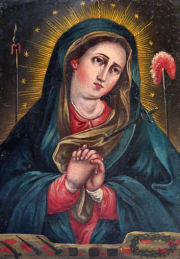 God vouchsafed to select the very things about Him which are most incommunicable, and in a most mysteriously real way communicate them to her. See how He had already mixed her up with the eternal designs of creation, making her almost a partial cause and partial model of it. Our Lady's co-operation in the redemption of the world gives us a fresh view of her magnificence. Neither the Immaculate Conception nor the Assumption will give us a higher idea of Mary's exaltation than the title of co-redemptress. Her sorrows were not necessary for the redemption of the world, but in the counsels of God they were inseparable from it. They belong to the integrity of the divine plan. Are not Mary's mysteries Jesus' mysteries, and His mysteries hers? The truth appears to be that all the mysteries of Jesus and Mary were in God's design as one mystery. Jesus Himself was Mary's sorrow, seven times repeated, aggravated sevenfold. During the hours of the Passion, the offering of Jesus and the offering of Mary were tied in one. They kept pace together; they were made of the same materials; they were perfumed with kindred fragrance; they were lighted with the same fire; they were offered with kindred dispositions. The two things were one simultaneous oblation, interwoven each moment through the thickly crowded mysteries of that dread time, unto the eternal Father, out of two sinless hearts, that were the hearts of Son and Mother, for the sins of a guilty world which fell on them contrary to their merits, but according to their own free will.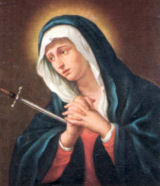

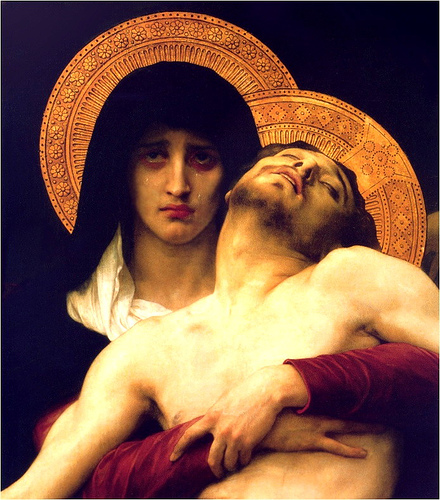
 1. When the time came for their purification according to the law of Moses, they brought him up to Jerusalem to present him to the Lord
 1. When the Magi had departed, behold, an angel of the Lord appeared to Joseph in a dream
 1. Now his parents went to Jerusalem every year at the feast of the Passover. And when he was twelve years old, they went up according to custom;
 1. So they took Jesus, and he went out, bearing his own cross.
 1. And they brought him to the place called Gol'gotha (which means the place of a skull).
 1. In order to prevent the bodies from remaining on the cross on the sabbath, the Jews asked Pilate that their legs might be broken, and that they might be taken away.
 1. Joseph took the body, and wrapped it in a clean linen shroud,