Tuesday, 18 December 2012

Pannenberg - a surprise introduction


18th December  O Antphon "O ADONAI".

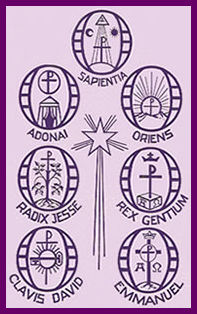
Novice took the photo at Lauds. I was simply admiring the cover of the Advent Hours.

The second day is of  'O Adonai' (click enlarge the Hebrew) - a pause of prayer.
   

Later the interest appears on the Website focus on Wolfhard Pannenberg.
The quotes beautifully point to "a transcendent experience of Divine Light".
1960-70s Librarian valued Pannenberg volumes on the shelves. At the end of 2012 the discovery is a Christmas gift.

Monday, 17 December 2012

O Antiphon December 18: "O Adonai"

http://dailygospel.org/
Tuesday, 18 December 2012

The Great O Antiphons: "O Adonai"


The Great O Antiphons
December 18: "O Adonai"

These Great «O Antiphons" at the Magnificat were first used by the Church in the 8th and 9th centuries.
They are said in order, based on various titles for the Christ and are scripturally-based short prayers for the 17th to the 23rd of December.
In these "O Antiphons" the Church expresses her deep longing for the coming of the Messiah.

Christ, Lawgiver and Redeemer of Israel
(See Exodus 3; Micah 5:2; Matthew 2:6)
O Adonai,
et dux domus Israël,
qui Moyse in igne flammae rubi apparuisti,
et ei in Sina legem dedisti:
veni ad redimendum nos in brachio extento.
O Mighty Lord,
and leader of the house of Israël,
who appeared to Moses in the burning bush,
and on Sinai gave him the law,
come to redeem us with outstretched arm.


Late Advent Day 17th O Wisdom


Advent: December 17th

Monday of the Third Week of Advent 

 http://www.catholicculture.org/culture/liturgicalyear/calendar/day.cfm?date=2012-12-17 

Click on symbols to see the day.
O WISDOM
December 17
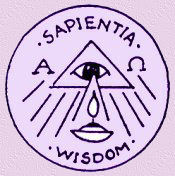
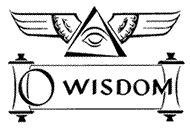
Symbols: All-Seeing Eye and the Lamp
Come, and teach us the way of prudence.
O Wisdom, who came from the mouth of the Most High, reaching from end to end and ordering all things mightily and sweetly, Come, and teach us the way of prudence.
O Sapientia, quae ex ore Altissimi prodiisti, attingens a fine usque ad finem fortiter, suaviterque disponens omnia: veni ad docendum nos viam prudentiae.
The "all-seeing eye" represents the all-knowing and ever-present God. During the late Renaissance, the eye was pictured in a triangle with rays of light to represent the infinite holiness of the Trinity. The lamp is a symbol of wisdom taken from the parable of the wise and foolish virgins in Matthew 25.
Recommended Readings: Proverbs 8:1-12


December 17 marks the beginning of the O Antiphons, the seven jewels of our liturgy, dating back to the fourth century, one for each day until Christmas Eve. These antiphons address Christ with seven magnificent Messianic titles, based on the Old Testament prophecies and types of Christ. The Church recalls the variety of the ills of man before the coming of the Redeemer.

O Wisdom
Divine Wisdom clothes itself in the nature of a man. It conceals itself in the weakness of a child. It chooses for itself infancy, poverty, obedience, subjection, obscurity. "I will destroy the wisdom of the wise and the prudence of the prudent I will reject. . . . Hath not God made foolish the wisdom of this world? For seeing that in the wisdom of God the world by wisdom knew not God, it pleased God, by the foolishness of our preaching, to save them that believe. For both the Jews require signs, and the Greeks seek after wisdom; but we preach Christ crucified, unto the Jews, indeed, a stumbling block, and unto the Gentiles foolishness; but unto them that are called, both Jews and Greeks, Christ, the power of God and the wisdom of God. . . . But the foolish things of the world hath God chosen, that He may confound the wise; and the weak things of the world hath God chosen, that He may confound the strong. And the base things of the world and the things that are contemptible, hath God chosen, and the things that are not, that He might bring to naught the things that are" (I Cor. 1:19 ff.).
  • Come, O divine Wisdom, teach us the way of knowledge. We are unwise; we judge and speak according to the vain standards of the world, which is foolishness in the eyes of God.
  • Come, O divine Wisdom, give us the true knowledge and the taste for what is eternal and divine. Inspire us with a thirst for God's holy will, help us seek God's guidance and direction, enlighten us in the teachings of the holy gospel, make us submissive to Thy holy Church. Strengthen us in the forgetfulness of self, and help us to resign ourselves to a position of obscurity if that be Thy holy will. Detach our hearts from resurgent pride. Give us wisdom that we may understand that "but one thing is necessary" (Luke 10:42). "For what doth it profit a man if he gain the whole world and suffer the loss of his own soul?" (Matt. 16:26.) The Holy Spirit would have us know that one degree of grace is worth more than all worldly possessions.
Excerpted from The Light of the World by Benedict Baur, O.S.B.

1st O Antiphon: 
Who hast issued from the mouth of the Most High, Reaching from end even unto end, Ordering all things indomitably yet tenderly,
COME
To teach us the way of prudence.
Today is Day Two of the Christmas Novena.


COMMENT: Dave Brubeck

The illustration of The Catholic Herald feature on the
death of Dave Brubeck caught interest.
It was the only article I read in the browse of headings of the newspaper.
The subject is riveting.
It is wonderful story and introduction to the
amazing jazz musician and composer.


www.bbc.co.uk/.../de0222a6-e1c4-403d-8b01-3f66d505061b

Darius Brubeck - The Jazz House interview. Dave Brubeck's son Darius talks about his father's iconic track "Take Five". Featured on BBC MUSIC SHOWCASE ...

Darius Brubeck - The Jazz House interview  
 
http://www.bbc.co.uk/programmes/p00zmm97  

Dave Brubeck,

the jazz giant who inspired Clint

Dave Brubeck, 90 next month, talks to Adam Sweeting about starring
in Clint Eastwood's latest film.  

“My own Brubeck Institute in California is turning out fantastic young jazz players, and I know great things will happen.”
Not even Clint Eastwood’s new film, Dave Brubeck – In His Own Sweet Way, can fully encompass Brubeck’s life and work despite being 90 minutes long and crammed with music, anecdotes and superb archive material. It’s still a great place to start. It traces Brubeck’s life from his upbringing on a northern Californian cattle ranch, via combat duty in the US Army in World War Two, to musical studies with the French composer Darius Milhaud, and thence to one of the mightiest careers in American music.
As Eastwood explains: “My early love of jazz coincided with Dave Brubeck appearing on the scene in the late 1940s and Fifties. This gave me the opportunity to see Dave in person. And, as jazz was developing as a great American art form, this provided an inspiration for artistic achievement as I began pursuing an acting career.” The film, he hopes, will “capture Dave, his life and music for the ages”.
Fr Stephen Wang on Dave Brubeck
- jazz musician, Catholic convert who wrote a Mass setting!  
  

Dave Brubeck at his home in
Connecticut. He recorded his last
album in 2011. Photo: CNS
The jazz musician and composer Dave Brubeck died on Wednesday at the age of 91. Fr Stephen Wang writes in his blog Bridges and Tangents: 'His recordings were the first jazz I ever listened to, on a scratchy LP from my dad’s collection; and Paul Desmond’s lyrical playing on Take Five was one of the main reasons I took up alto sax as a teenager.'... Fr Stephen goes on to include a beautiful tribute to Brubeck and a link to a live studio version of Take Five - to read more see:  http://bridgesandtangents.wordpress.com/2012/12/05/dave-brubeck-rip/
In his next blog, Fr Stephen speaks about Brubeck's conversion to the Catholic faith:  For years, he asserted he was not a convert, saying: "to be a convert you needed to be something first" - Brubeck said he was “nothing” before he was welcomed into the Church.
His Mass has been performed throughout the world, including in the former Soviet Union in 1997, and for Pope John Paul II in San Francisco during the pontiff’s 1987 pilgrimage to the United States. See: http://bridgesandtangents.wordpress.com/2012/12/06/and-dave-brubeck-was-a-catholic-convert-who-wrote-a-musical-setting-for-the-mass/


Sunday, 16 December 2012

Dave Brubeck Catholic jazz pianist dies


Requiescat in pace: Dave Brubeck, jazz giant and convert to Catholicism from "nothing"
By Carl E. Olson

Wednesday, December 05, 2012
Dave Brubeck, legendary jazz pianist and pioneer, died earlier today on the cusp of his 92nd birthday. Fromthe Chicago Tribune:
Dave Brubeck, a jazz musician who attained pop-star acclaim with recordings such as "Take Five" and "Blue Rondo a la Turk," died Wednesday morning at Norwalk Hospital, in Norwalk, Conn., said his longtime manager-producer-conductor Russell Gloyd.

Brubeck was one day short of his 92nd birthday. He died of heart failure, en route to "a regular treatment with his cardiologist,” said Gloyd.

Throughout his career, Brubeck defied conventions long imposed on jazz musicians. The tricky meters he played in “Take Five” and other works transcended standard conceptions of swing rhythm.


The extended choral/symphonic works he penned and performed around the world took him well outside the accepted boundaries of jazz. And the concerts he brought to colleges across the country in the 1950s shattered the then-long-held notion that jazz had no place in academia.

As a pianist, he applied the classical influences of his teacher, the French master Darius Milhaud, to jazz, playing with an elegance of tone and phrase that supposedly were the antithesis of the American sound.
The New York Times has a lengthy obituary that highlights Brubeck's long, active, and prolific life as musician and composer:
In 1954 Mr. Brubeck was the first jazz musician to be featured on the cover of Time magazine. That same year he signed with Columbia Records, promising to deliver two albums a year, and built a house in Oakland.
For all his conceptualizing, Mr. Brubeck often seemed more guileless and stubborn country boy than intellectual. It is often noted that his piece “The Duke” — famously recorded by Miles Davis and Gil Evans in 1959 on their collaborative album “Miles Ahead” — runs through all 12 keys in the first eight bars. But Mr. Brubeck contended that he never realized that until a music professor told him.
Mr. Brubeck’s very personal musical language situated him far from the Bud Powell school of bebop rhythm and harmony; he relied much more on chords, lots and lots of them, than on sizzling, hornlike right-hand lines. (He may have come by this outsiderness naturally, as a function of his background: jazz by way of rural isolation and modernist academia. He was, Ted Gioia wrote in his book “West Coast Jazz,” “inspired by the process of improvisation rather than by its history.”)
It took a little while for Mr. Brubeck to capitalize on the greater visibility his deal with Columbia gave him, and as he accommodated success a certain segment of the jazz audience began to turn against him. (The 1957 album “Dave Digs Disney,” on which he played songs from Walt Disney movies, didn’t help his credibility among critics and connoisseurs.) Still, by the end of the decade he had broken through with mainstream audiences in a bigger way than almost any jazz musician since World War II.
In 1958, as part of a State Department program that brought jazz as an offer of good will during the cold war, his quartet traveled in the Middle East and India, and Mr. Brubeck became intrigued by musical languages that didn’t stick to 4/4 time — what he called “march-style jazz,” the meter that had been the music’s bedrock. The result was the album “Time Out,” recorded in 1959. With the hits “Take Five” (composed by Mr. Desmond in 5/4 meter and prominently featuring the quartet’s gifted drummer, Joe Morello) and “Blue Rondo À la Turk” (composed by Mr. Brubeck in 9/8), the album propelled Mr. Brubeck onto the pop charts. ...
As a composer, Mr. Brubeck used jazz to address religious themes and to bridge social and political divides. His cantata “The Gates of Justice,” from 1969, dealt with blacks and Jews in America; another cantata, “Truth Is Fallen” (1972), lamented the killing of student protesters at Kent State University in 1970, with a score including orchestra, electric guitars and police sirens. He played during the Reagan-Gorbachev summit meeting in 1988; he composed entrance music for Pope John Paul II’s visit to Candlestick Park in San Francisco in 1987; he performed for eight presidents, from Kennedy to Clinton.

Much more about Brubeck's life and discography can be found on the All Music Guide site. As Deacon Greg Kandra points out (and I noted in this May 2011 post), Brubeck was also a convert, in 1980, to the Catholic Church. This 2009 article in St. Anthony Messenger states:
To Hope! A Celebration was Brubeck’s first encounter with the Roman Catholic Mass, written at a time when he belonged to no denomination or faith community. It was commissioned by Our Sunday Visitoreditor Ed Murray, who wanted a serious piece on the revised Roman ritual, not a pop or jazz Mass, but one that reflected the American Catholic experience.
The writing was to have a profound effect on Brubeck’s life. A short time before its premiere in 1980 a priest asked why there was no Our Father section of the Mass. Brubeck recalls first inquiring, “What’s the Our Father?” (he knew it as The Lord’s Prayer) and saying, “They didn’t ask me to do that.”
He resolved not to make the addition that, in his mind, would wreak havoc with the composition as he had created it. He told the priest, “No, I’m going on vacation and I’ve taken a lot of time from my wife and family. I want to be with them and not worry about music.”
“So the first night we were in the Caribbean, I dreamt the Our Father,” Brubeck says, recalling that he hopped out of bed to write down as much as he could remember from his dream state. At that moment he decided to add that piece to the Mass and to become a Catholic.
He has adamantly asserted for years that he is not a convert, saying to be a convert you needed to be something first. He continues to define himself as being “nothing” before being welcomed into the Church.
His Mass has been performed throughout the world, including in the former Soviet Union in 1997 (when Russia was considering adopting a state religion) and for Pope John Paul II in San Francisco during the pontiff’s 1987 pilgrimage to the United States. At the latter celebration, Brubeck was asked to write an additional processional piece for the pope’s entrance into Candlestick Park.
Again, it was a dream that led him to accept a sacred music project that he initially refused as not workable. The dream “was more of a realizing that I could write what I wanted for the music,” Brubeck says.
“They needed nine minutes and they gave me a sentence, ‘Upon this rock I will build my Church and the jaws of hell cannot prevail against it.’ So rather than dream musically, I dreamed practically that Bach would have taken one sentence in a chorale and fugue, as he often did, and that was the answer,” he says. “So I decided that I would do that piece for the pope,” which is known as “Upon This Rock.”

If I might, here are some thoughts from a post I wrote last year on the "catholicity of jazz", with a reference to Brubeck:
Brubeck composed a piece, "To Hope! A Celebration Mass" in 1996 that seems to have a much more classical/European sound to it. Regardless, I've long said that I never want to hear jazz at Mass, now matter how well it is played or composed, for while jazz is very beautiful, powerful, and even spiritual (in the best sense of that word), it's very nature—improvisational, largely profane (in the correct sense of that word)—is not well-suited, in my judgment, to liturgical settings.
But I would also insist that outside of liturgical settings, good jazz is good music, which means it is an artistic expression in keeping with Catholicism, which prizes and recognizes all that is good, true, and beautiful. Personal tastes differ, it goes without saying, and I can only take a little bit of Ornette Coleman or Cecil Taylor before I turn to the Blue Note albums of the 1950s and '60s, or the trio albums of Keith Jarrett, or the recent works of Joshua Redman, Brad Mehldau, Roy Hargrove, and so forth. Great jazz, to my mind and ear, is a marvelous combination of structure and improvisation, where intelligent musical conversation takes place upon a chosen, mutual theme, revealing both the individual thoughts/voices of those participating, as well as the deeper meaning and heart of the piece they are playing. It is a music that recognizes and honors and draws upon tradition while speaking about and within that tradition in the here and now. In my mind, jazz bears a certain analogy to the human condition: we are creatures endowed with great freedom, but freedom is to be exercised in pursuing the good, recognizing and respecting the limits and boundaries of our nature and of creation as established by God the Creator.
May God grant him eternal rest! 
From Catholic World Report | Copyright © 2012 Catholic World Report All Rights Reserved.

COMMENT: Advent Third Sunday

Third Sunday of Advent
Thank you, William.
A must, for the Website of Carlisle St. Augustine's.
D. 

From: William W...>
Subject: Las Posadas
To: Donald....>
Date: Sunday, 16 December, 2012, 9:24

Dear Father Donald,

I am delighting in the link you gave on your Blog a little while agohttp://www.instituteforchristianformation.org/AdventCalendarYOG2013/ThirdSundayofAdvent.html which today introduces us to a lovely custom, Las Posadas. It has delighted me and confirmed the tradition being continued in one parish in Carlisle under Fr. Geoffrey Steel:

St. Augustine's newsletter:

Our Children’s Liturgy
team is organising the Travelling Nativity: At the
beginning of Advent, Mary & Joseph leave for Bethlehem, and the children of
our parish offer them a place to stay for each night until Christmas.
It is always a joy to learn of such traditions passing from one generation to another uniting a parish community.

With my love in Our Lord,
William 

In addition to being the Third Sunday of Advent, or Guadete Sunday, today is also December 16, the day of the beginning of the Las Posadas celebration. "Las Posadas" is Spanish for lodgings or inns.  Recall that in Luke’s account of the birth of Jesus, the infant Jesus was laid in a manger because there was no room for Mary and Joseph in the inn. (Luke 2:7) In many Hispanic cultures, there is a tradition of a novena (nine day prayer) preparing for Christmas.  This includes the celebration of Las Posadas.  Las Posadas begins on December 16 and concludes on Christmas Eve, December 24.

Las Posadas may involve an entire neighborhood or village.  It is a reenactment of Mary and Joseph searching for lodging in Bethlehem, as they awaited the imminent birth of Jesus.  Each evening of Las Posadas, those participating process from home to home asking for lodging and hospitality.  The participants may be led by two people dressed as Mary and Joseph.  Perhaps Mary might even be riding on a donkey!  Sometimes two children play the roles of Mary and Joseph, or the participants might carry statues of Mary and Joseph in their procession.  The pilgrims are rudely turned away, until finally they find hospitality and are welcomed in!  There are traditional songs for the Las Posadas celebration, and luminaria light the way.  The home offering hospitality generally has a manger set up.  The pilgrims have a small statue of the Christ Child which they place in the manger.  Las Posadas ends with the breaking of a piñata, and is usually followed by participants going to church to celebrate Midnight Mass.